Why You Need Marine Insurance for Cargo Shipping
What is Marine Insurance?
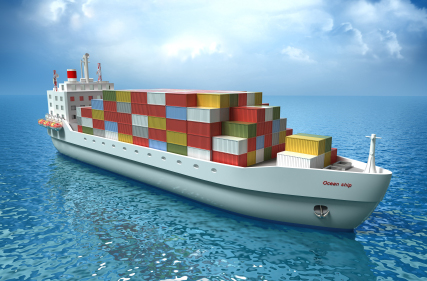
Marine insurance for cargo shipping covers the loss or damage of the cargo while on the water, as well as during transport to and from the port terminals. It is also referred to as cargo insurance, marine cargo insurance, or marine shipping insurance.
Our customers have the option to purchase marine cargo insurance when exporting vehicles and household goods; if you choose to do this, you would provide your marine insurance form with your exported shipment.
What Does Marine Cargo Insurance Cover?
Like other forms of insurance, you may hesitate at purchasing marine cargo insurance in the case you won’t need it in the end. If your cargo goes missing or if the shipping containers are damaged, you’ll be relieved to know your items are covered and you won’t suffer the cost. A few instances where damages or loss may occur include:
General Average
General average is a legal principle of maritime law in which all parties involved in a maritime accident will proportionally share the common loss. If your cargo is protected by marine insurance, the insurance company will cover your portion of the loss.
Natural Disasters
Your cargo or its container may suffer damage or go missing completely after a tsunami, hurricane, earthquake or similar incident. Since cargo insurance applies during transport to and from the port terminals, your shipment would be covered on both land and sea.
Theft
Your shipment could be stolen in the case of piracy or other theft. And even if your shipment isn’t the target, its arrival may be delayed after this event. In this case, the insurance company would replace the stolen items or reimburse the financial loss to you.
Learn More about Marine Insurance from Schumacher Cargo Logistics
To learn how to get cargo insurance or how much marine cargo insurance costs, contact one of our moving specialists today. Our 40 years of experience in international vehicle shipping and overseas relocation makes us experts in safely and efficiently getting your items where they need to be. Get your free shipping quote from Schumacher Cargo Logistics today!
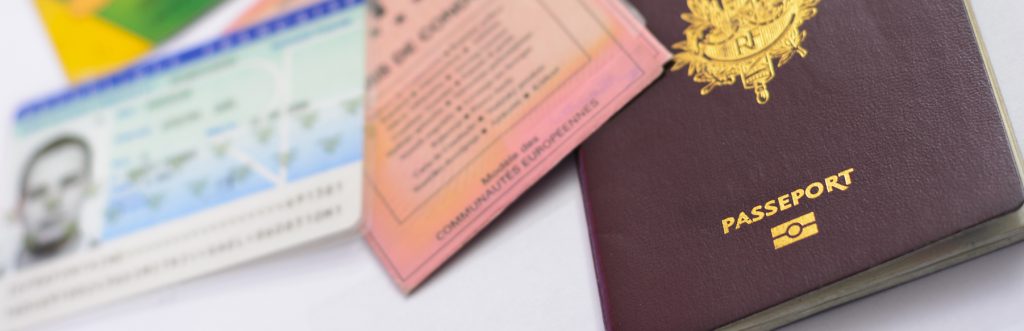
At Schumacher Cargo Logistics, we’re experts in shipping vehicles overseas or exporting household goods. However, not everyone knows what’s required and we receive a lot of questions about what documents our customers need when moving internationally. For your convenience, we’ve compiled a helpful guide to explain some of the most common documents required when exporting an automobile or household goods.
Documents for Vehicle Export from USA
- Passport
- A clear scanned copy with the passport number
- If it’s a U.S. passport, it needs to include the Employer Identification Number (EIN)
- If it is not a U.S. passport, no EIN is needed
- Receive your Employer Identification Number with the EIN Assistant
- Certificate of Title
- The shipper’s name has to be the current owner of the vehicle listed on the title
- Bill of Sale
- Power of Attorney, depending on the port
Documents for Exporting Household Goods
- Passport
- A clear scanned copy with the passport number
- If it’s a U.S. passport, it needs to include the Employer Identification Number (EIN)
- If it is not a U.S. passport, no EIN is needed
- Receive your Employer Identification Number with the EIN Assistant
- Valuation of the shipment, as required by U.S. Customs
- Signed Schumacher Quotation
- Marine Insurance Form, if applicable
For Temporary Exports
If you are only exporting your vehicle for a temporary amount of time, you can get an ATA Carnet. This specialized document allows you to bring your car and household goods overseas for up to a year, and then the item(s) need to be brought back. For example, you would use this document if you were shipping your car overseas for a race or a show; after the event, the car would be returned to the United States.
Using this document gives you the benefit of bringing your vehicle and household goods into the country duty and tax free. In addition, you cannot sell the item(s) with a carnet overseas.
Documents for Exporting Items, by Country
Note that the lists above are not exhaustive; these documents are only the most commonly required. Each country will have its own specific requirements for exported items. Here are some examples of the different documentation required by Australia, France and the United Kingdom.
Australia
- B534 Form – Unaccompanied Personal Effects Statement
France
- Inventaire pour la Douane Française / Inventory for French Customs
- CERFA 10070*02
- Certificate of Non-Resale
United Kingdom
How Schumacher Cargo Logistics Can Help You Export Your Items
To keep things in order, Schumacher Cargo Logistics provides to our customers a checklist to ensure that all required documents are received, as well as assistance if you need help completing the documents. In addition, you will receive a booking confirmation letter containing details of your shipment and information for the documents required by your destination country.
For more information about moving and shipping internationally, call our moving specialists toll-free at 800-599-0190 or request your free shipping quote today.
Touring Europe via Motorcycle
Traveling across Europe is an activity found on bucket lists all over the world. And it’s no surprise why: the continent is rich in history, culture and landscapes. With this many neighboring countries so close to each other, traveling throughout the continent is relatively easy.
Instead of backpacking through Europe, though, consider experiencing this amazing continent all from the back of your motorcycle. By traveling on a motorcycle, you get a 360-degree experience unlike what you would in a car or a bus. You’ll experience the twists and turns of Europe’s valleys and mountains, as well as be part of a community that also loves touring via motorcycle.
Take a look at our guide for motorcycle tours in Europe below!
Tips for Planning a Motorcycle Trip in Europe:
- Before your trip, take your motorcycle in for a complete service. Make sure everything is operating the way it should. The last thing you want is to be stranded in the middle of the Alps because your motorcycle needs a repair.
- Since Europe stretches from the Arctic Circle down to Africa, the weather across the continent varies by geographical region and time of year. Think about when and where you’ll be traveling, then pack and plan appropriately.
- Pack lightly and efficiently. Have an emergency bag packed separately from the rest of your items, and secure it in an easily accessible spot so that you can grab it immediately should anything happen.
- Booking through a tour company relieves the pressure of having to plan and arrange your trip yourself. If you don’t want to book through a company and prefer the do-it-yourself approach, check out the suggested routes below.
Motorcycling Routes through Europe by Region
Europe is a large continent, so there are many great motorcycle trails in different regions. Each one has unique sights and are all amazing routes in their own rights. See which route interests you the most.
Trans European Trail
The Trans European Trail stretches for 21,000 miles (34,000 kilometers), coursing all throughout the continent. Traveling this path could essentially be your one stop shop for seeing all of Europe. It’s cared after solely by volunteers named “Linesmen,” who each represent their respective country and the part of the road coursing through it.
The British Isles
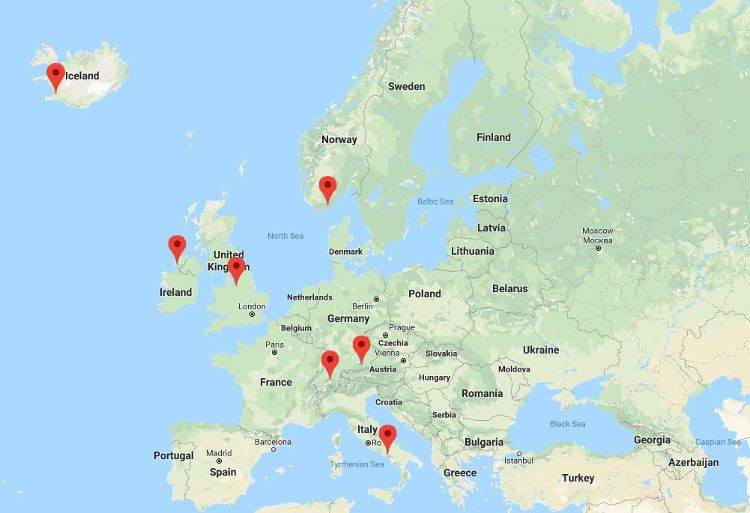
The Cat and Fiddle Run, United Kingdom
While it’s technically named the A537 Buxton New Road, the Cat and Fiddle Run gets its nickname after a pub of the same name found along the route. The road is about 12.5 miles long, with most of it cutting through the Peak District National Park. Be careful, though, as it’s known as Britain’s most dangerous road because of the sharp drops and bends along the way.
Wild Atlantic Way, Ireland
Its total distance of 1,553 miles (2,500 kilometers) makes it the longest coastal route in the world. Travel along Ireland’s Atlantic coast, and you’ll go through six regions of the Emerald Isle. Taste the salty air on this scenic route featuring beaches, cliffs and coastal towns.
Nordic Region
Kristiansand to Bergen, Norway
Travel along Norway’s southern region on this 273-mile (468 kilometers) long journey. Before heading out, consider the time of year you’re traveling; winter in Norway can last from September to June, giving you a limited window of bearable traveling. However, it’s totally worth it for the incredible fjords.
The Iceland Ring Road, Iceland
This 828-mile loop takes you around the outer edges of Iceland. Plan to spend about seven days to see all that Iceland has to offer: volcanoes, icebergs, waterfalls, the Northern Lights and more amazing sights.
Mediterranean
Amalfi Coast Road, Italy
This 446-mile long road is also called “The Road of a Thousand Bends” for its crazy dips, climbs and turns. This area was named a UNESCO World Heritage Site as a cultural landscape in 1997. It’s advised to visit in the off-season because the summer traffic can be horrendous.
The Alps
Alpine Road, Germany
The German Alpine Road, or “Alpenstrasse,” is about 280 miles (450 kilometers) of road passing through incredible landscapes. You’ll see mountains, farmland, lakes, valleys, meadows, castles and so much more on this trek.
Furka Pass, Switzerland
One of the highest mountain passes of the Alps, this pass is featured in the car chase scene in James Bond’s Goldfinger. More than 250,000 people cross the pass each year in cars, motorcycles, train and bus. Switchbacks, glaciers, and the threat of landslides, avalanches and heavy snowfalls make this pass one of the most adrenaline-inducing rides in the world.
Ship Your Motorcycle to Europe with Schumacher Cargo Logistics
Ready to hit the road? Schumacher Cargo Logistics offers the best services and rates for shipping to Europe. Check out our page on shipping your motorcycle to Europe. With a multitude of ports throughout the continent, all you have to do is decide where to go! To get started, request a free online estimate or talk to one of our specialists at 562-408-6677 or toll-free at 800-599-0190.
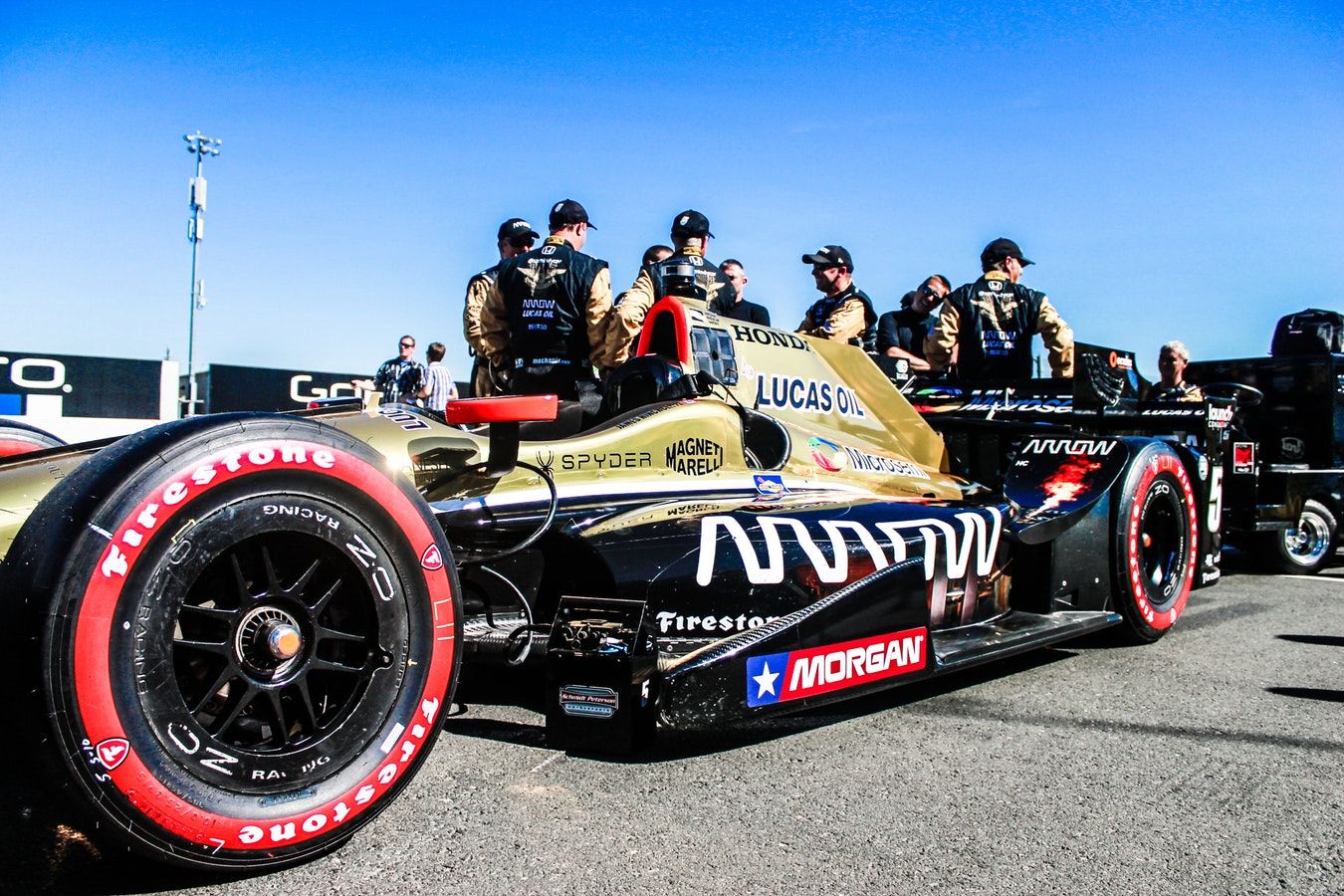
Summer in the United States unofficially begins on Memorial Day weekend. For the city of Indianapolis, however, there’s more to it than a holiday weekend.
The Indianapolis 500 is held annually on the Sunday of Memorial Day weekend. It’s known as “The Greatest Spectacle in Racing,” and it’s no wonder why. Thirty-three drivers race for 500 miles, reaching speeds up to 221 miles per hour, in aptly-named IndyCars. Approximately 300,000 patrons make it to the Speedway each year.
The 102nd Indianapolis 500 will take place on Sunday, May 27, 2018 at 12:19 p.m. EDT. This year, Hollywood actor Chris Hemsworth is the unofficial starter for the race, and pop star Kelly Clarkson will sing the national anthem. The rock/pop band Train will headline the Carb Day concert on Friday, May 25, and country artist Sam Hunt will lead the Legends Day concert on Saturday, May 26.
Events leading up to the race include a festival, concerts, services honoring the Armed Forces, and a scholarship program that crowns 33 college-aged women as 500 Festival Princesses. The Indianapolis Motor Speedway also hosts the Brickyard 400, IndyCar Grand Prix, Brickyard Vintage Racing Invitational and an annual mini-marathon.
Indy 500 Traditions
- Kissing of the Bricks: After winning the 1996 Brickyard 400, NASCAR driver Dale Jewett and his crew chief Todd Parrott kneeled and kissed the Yard of Bricks that create the start-finish line at the track. The rest of the team joined, and they started a tradition that both Indianapolis 500 and Brickyard 400 champions have followed ever since.
- Drinking of the Milk: Three-time Indianapolis 500 winner Louis Meyer drank buttermilk as a refreshment on a hot day; this habit had him requesting the drink after his win in 1936. An executive from the (then) Milk Foundation saw the photo in the newspaper the next morning, and he was so pleased that he promised to repeat that custom in the upcoming years.
- “Back Home Again in Indiana”: While it isn’t the state song, “Back Home Again in Indiana” has been played prior to the drivers starting their engines since 1946. A huge release of red, white and blue balloons is timed with the final notes of the song.
Historic Moments at the Indianapolis Motor Speedway
- The fastest lap ever completed during the race was in 1996 by Eddie Cheever, Jr. His speed was 236.103 mph, taking 38.119 seconds to go completely around the track.
- At the 100th Indianapolis 500 in 2016, 24-year-old rookie driver Alexander Rossi won the race. His average speed was 166.634 mph.
- in 1975, the Indianapolis Motor Speedway joined the National Register of Historic Places. It was designated as a National Historic Landmark in 1987.
- Drivers with most wins: AJ Foyt (4), Al Unser (4), Pick Mears (4)
- Team with most wins: Penske (16)
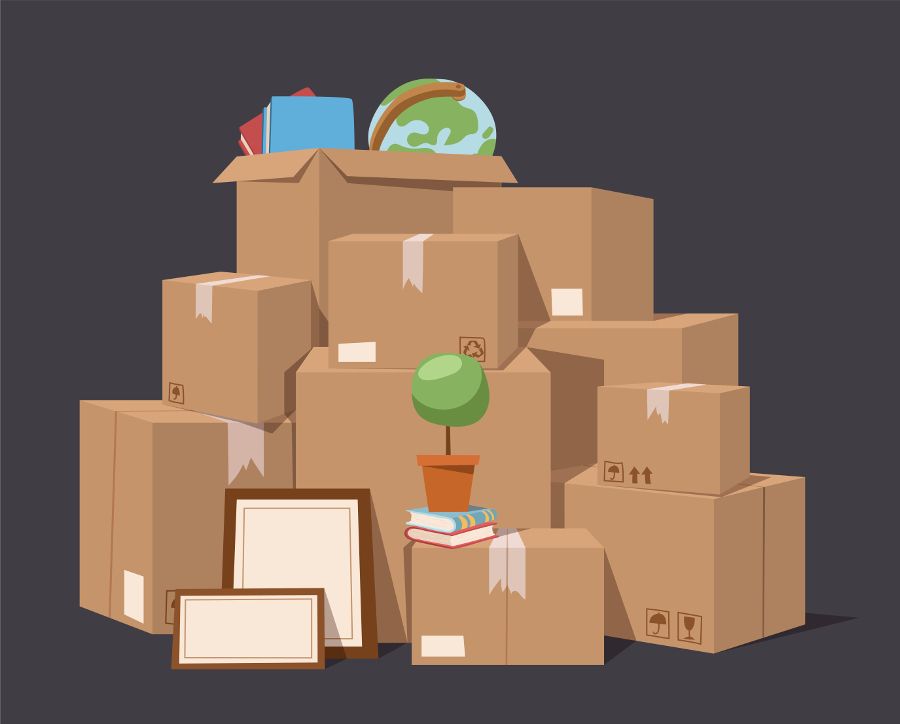
When you’re in the midst of a move, it’s hard to nail down exactly what you’ll need on hand to help you pack. Here, we’ve compiled a handy list that you can use as your go-to packing guide.
- Boxes of various sizes
- Plastic tubs with lids for storage
- Packing material like bubble wrap, newspaper, packing peanuts, etc.
- Tape and tape dispensers
- Duct tape
- Packing tape
- Masking tape for labeling
- Painter’s tape for quick touch-ups
- Scissors, box cutters
- Stickers for labeling and color-coding boxes to each room
- Permanent marker
- Trash bags
- Furniture pads and covers (blankets work just as well)
- Dollies and hand trucks
- Rope, twine, bungee cords to hold things in place during transport
- Padlocks if items will be in the moving van overnight
- Toolbox
- Cleaning supplies
Once you’ve moved past the packing supplies, you’ll want to make sure you have your personal essentials easily accessible. The last thing you want to do on your first night in your new house is unpack a hundred boxes trying to find your toothbrush. Pack these items up last, as you’ll want to make sure they’re the first things you grab from the moving van.
- Toilet paper
- Hand soap
- Dish soap and dish towel
- Paper towels
- Snacks
- Beverages
- Plates, utensils, napkins
- Pet supplies
- Emergency kit, first-aid kit
- Flashlight, candles, matches
- Shower curtain
- Shampoo, conditioner, body wash, and other related items
- Personal information, like birth certificates, passports, marriage licenses, etc.
- Clothes for the upcoming days
- Toiletries
- Backpacks and school supplies
- Electronics and accompanying chargers
- Cooler, ice or ice packs
- Medicine, prescriptions
- Cell phone
- Sheets, blankets
- Pillows
- Sleeping bags
- Anything else you may need within 24 hours of packing and moving