Will Your American Furniture Fit in a German Home?

If you are moving from the United States to Germany, you may be wondering what to do with all your furniture. Should you ship your sofa, dining table, beds, and dressers overseas, or sell everything and start over after you arrive?
For most people, the answer is somewhere in the middle.
Some furniture is absolutely worth bringing with you. Other pieces may take up valuable shipping space only to become a headache when they do not fit through the stairwell of your new apartment.
The important thing is not to assume that every German home is smaller than an American home. Instead, start with the home you are actually moving into and decide what makes sense to bring from there.
How Are German Homes Different From American Homes?
German homes vary considerably depending on where you live. A modern house outside Stuttgart may have plenty of room for the furniture from your U.S. home, while an older apartment in Berlin could have narrower stairways, smaller rooms, or a completely different layout.
Square footage is not the only thing to consider.
Room layouts, built-in storage, elevators, stairways, and even what comes with a rental can be different from what Americans are used to. Long-term rentals in Germany are also not always furnished, and some may not include a kitchen.
That is why it is a good idea to learn as much as possible about your new home before deciding what goes into your international shipment.
If you can, get a floor plan and take measurements in centimeters. And remember: just because your sofa fits in the living room does not mean it will fit through the front door.
Before deciding what to ship, check:
- Room dimensions: Measure wall lengths, ceiling heights, windows, radiators, and the direction doors open.
- The delivery route: Look at the building entrance, apartment door, hallways, stair landings, and tight corners.
- Elevator dimensions: Do not just ask whether there is an elevator. Find out how large the door opening and interior actually are.
- What comes with the home: Find out whether your kitchen, appliances, closets, or other storage will already be there.
- Moving-day access: Ask where a moving truck can stop and whether parking or building access needs to be arranged ahead of time.
Large Furniture: Measure More Than the Room
Sofas, sectionals, recliners, dining sets, and large armoires are usually the main pieces worth measuring carefully.
Measure each piece at its widest, deepest, and tallest points. It is also helpful to know whether legs, backs, shelves, or sections can be safely removed for moving.
Sometimes the furniture that looks biggest is not actually the hardest to move. A large modular sectional that comes apart into several pieces may be easier to get into an apartment than a smaller sofa with a rigid frame.
Think about how you will use the room, too. Your dining table may have had its own room in your American home, while your new dining area may also need to function as an office or provide additional storage. In that case, bringing the table and chairs may make sense while leaving the large hutch behind.
Wardrobes and Storage Furniture Can Be Worth Bringing
Large wardrobes and dressers take up quite a bit of space in an international shipment, so they can be tempting to leave behind.
But do not rule them out too quickly.
If your new home has limited built-in storage, those pieces could be much more useful in Germany than they were in your U.S. home.
Well-made storage furniture that can be safely disassembled and put back together is generally a better candidate for shipping than inexpensive particleboard furniture that may not survive being taken apart.
American Beds and Mattresses May Not Match European Sizes
U.S. and European mattress sizes do not match exactly.
If you want to bring an American bed frame, think about the entire setup: the frame, mattress, foundation, and even your bedding.
A bed you already own and love may be worth bringing. But if your mattress is nearing the end of its life anyway, when moving to Germany it may be a good opportunity to switch to a locally sized bed frame and mattress.
Check the Voltage Before Shipping Anything With a Plug
Furniture with electrical components requires a little more consideration.
German homes generally use 230-volt, 50-hertz electricity with Type C or Type F plugs. Simply adding a plug adapter does not change the voltage or frequency.
Before shipping an adjustable bed, powered recliner, lamp, appliance, or other electrical item, check the manufacturer’s label to see whether it is compatible. If you are unsure, check with the manufacturer or a qualified electrician before adding it to your shipment.
So, What Furniture Is Worth Shipping to Germany?
There is no universal list because the answer depends on your home, your shipment, and how important a particular piece is to you.
In general, furniture may be worth shipping when it fits your new home, can make it through the delivery route, and would be difficult or expensive to replace with something comparable.
That often includes:
- Well-made solid wood furniture
- Antiques and heirlooms
- Artwork, rugs, and sentimental pieces
- Modular furniture that can be safely disassembled
- Wardrobes, dressers, and other storage you know you will need
- Specialty furniture for work, hobbies, accessibility, or family needs
And sentimental value matters. The question is not always whether you could technically buy another dining table in Germany. If it is the table your family has gathered around for the last 15 years, replacing it may not be what you want to do.
What Might Be Better to Replace After You Move?
Other furniture may take up a significant amount of shipping space without providing enough value to justify bringing it.
You may want to consider replacing:
- Low-cost particleboard furniture that may not survive disassembly
- Oversized pieces you have not checked against your new layout
- Worn mattresses or upholstered furniture you were already planning to replace
- Large appliances that are incompatible with German power, connections, or room dimensions
You also do not have to make every decision at once. Once you know where you will be living and have accurate measurements, it becomes much easier to decide what deserves a place in your shipment.
What You Bring Affects Your Shipping Options
Deciding what stays and what goes is not just about whether your furniture will fit in your new home. It also affects the size of your international shipment.
Schumacher offers both shared-container and sole-use container options for moves to Germany. With shared-container service, the amount of space your household goods take up helps determine the cost of your shipment. Removing a few large pieces you do not really need can make a meaningful difference in your overall shipping volume.
Before your move, a pre-move survey can help determine how much you are actually shipping and which service makes the most sense.
Your furniture will also need to be included on your shipment inventory. Used household goods may qualify for duty-free import into Germany when transfer-of-residence requirements are met, but this is not automatic. Be sure to review the current German Customs requirements and let your moving coordinator know if you are bringing recently purchased furniture, antiques, or anything that may require additional documentation.
Bring the Furniture That Makes Sense for Your Move
Moving to Germany does not mean you have to sell everything you own and start over.
The goal is to bring the pieces that fit your new home, make everyday life easier, or simply mean enough to you that they are worth taking across the Atlantic. Knowing the dimensions of your new space and being realistic about what you will actually use can make those decisions much easier.
Not sure how much of your furniture makes sense to bring? Schumacher Cargo has been helping families move household goods overseas since 1977. Tell us where you are moving and what you are thinking about bringing, and our team can help you determine the right shipping option for your move to Germany.
Get Your Free International Moving Quote

Moving to Spain from the United States is exciting, but preparing for an international move involves much more than simply packing boxes and booking transportation. Spain has its own pace, housing realities, customs process, and lifestyle differences that can directly affect how you prepare before relocating overseas.
Many Americans begin the process focused mainly on shipping logistics, only to realize later that preparing for daily life in Spain is just as important. Understanding what to expect ahead of time can help make the transition smoother and reduce unnecessary stress during your move.
If you are still exploring the overall relocation process, our moving to Spain from the US guide provides a broader overview of international moving services, shipping options, and what to expect when relocating overseas.
1. Start Planning Earlier Than You Think
One of the biggest mistakes people make when moving to Spain is underestimating how much coordination is involved in an international move.
Between documentation, shipping schedules, customs clearance, and final delivery coordination, the process often takes longer than people initially expect. Spain can also move at a slower administrative pace than many Americans are used to, especially when it comes to scheduling appointments or processing paperwork.
Starting early gives you more flexibility and helps reduce stress later in the process.
2. Think Carefully About What You Bring
Many Americans moving to Spain eventually realize they have less space than they had in the United States.
Apartments in cities like Madrid, Barcelona, and Valencia are often smaller than typical American homes, and older buildings may have narrow stairways, smaller elevators, or limited access for large furniture deliveries.
Because of this, many people preparing for a move to Spain decide not to bring oversized furniture or unnecessary household items overseas. Taking time to simplify before your move can make unpacking and settling in much easier once you arrive.
3. Organize Important Documents Early
International moves require more documentation than domestic relocations, and staying organized becomes especially important when moving overseas. Some of the most important documents you will need include your passport, the appropriate Spanish visa (such as a Non-Lucrative Visa or Student Visa, depending on your situation), your Número de Identidad de Extranjero (NIE), customs forms for your shipment, and proof of residency or housing in Spain.
Before your move, it helps to keep important paperwork easily accessible, including:
- Passports
- Residency or visa documents
- Shipping paperwork
- Personal identification
- Detailed shipment inventories
Having everything prepared ahead of time can help prevent delays during customs clearance and delivery coordination later in the process.
4. Understand That Timelines Can Vary
Many Americans are surprised by how different international moving timelines can feel compared to domestic moves.
Factors such as shipping schedules, customs inspections, seasonal demand, and delivery coordination can all affect timing. In Spain, August can also slow things down significantly, as many businesses and services operate on reduced schedules during vacation season.
Building flexibility into your moving timeline can help reduce frustration and make the process feel far more manageable.
5. Prepare for a Different Style of Living
Part of preparing for a move to Spain is understanding how daily life may differ from what you are used to in the United States.
Many people rely more heavily on walking, trains, and public transportation, especially in larger cities. Grocery shopping is often done more frequently and in smaller quantities, partly because kitchens and storage spaces may be smaller than what Americans expect. You may also notice differences in meal times, as lunch is typically eaten later in the afternoon and dinner is often served as late as 9 or 10 p.m. Social customs can feel different, too; for example, it is common to greet people with a kiss on both cheeks, and many shops and businesses close for a midday break known as “la siesta.” Being aware of these cultural differences can help you adapt more easily to life in Spain.
Adjusting your expectations ahead of time can make the transition feel less overwhelming once you arrive.
6. Learn What You Can and Cannot Ship
Before moving overseas, it is important to understand that certain items may be restricted or prohibited during international shipping and customs clearance. Common restricted items include plants and seeds, certain types of electronics that do not meet European standards, food products such as meats and dairy, flammable materials, and some medicines or prescription drugs.
Some belongings may require additional documentation, while others may not be practical to bring depending on your destination and living space in Spain.
Reviewing shipping restrictions early can help avoid complications and make planning your household goods shipment much easier.
7. Prepare for More Walking and Less Storage
One thing many Americans do not fully expect until they arrive in Spain is how much more active and space-conscious daily life can become.
Whether it is climbing apartment stairs, walking through historic city centers, or adapting to smaller closets and kitchens, many people naturally shift toward a simpler lifestyle after relocating.
Preparing mentally for this adjustment before your move can help make the transition feel more exciting and less stressful.
8. Work With an Experienced International Moving Company
International moving involves much more than transporting belongings from one country to another. Packing, shipping coordination, customs clearance, and final delivery all need to work together smoothly.
Working with an experienced international moving company can help simplify the process and reduce the risk of delays or unexpected issues during your move to Spain.
Planning Your Move to Spain
Preparing for a move to Spain involves both practical planning and adjusting to a different style of living. The more you understand ahead of time, the easier it becomes to navigate the relocation process with confidence.
While some aspects of life in Spain may feel different at first, many Americans quickly adapt once they settle into their new routines and environment.
If you are ready to begin planning your move, you can also get a quote or call us at 1-800-599-0190 to speak with an international moving specialist about your relocation.

Moving household goods to the United Kingdom from the United States can feel overwhelming, especially when trying to understand customs, logistics, and what to expect during the process.
What matters most is understanding how international moving works and ensuring everything is handled correctly from the start.
How Moving Household Goods to the UK Works
Every international move involves a series of coordinated steps. When you work with a full-service international moving company, each stage is managed for you.
1. Survey & Planning
Your move begins with a survey to determine the volume of your belongings, packing needs, and the best shipping method. This ensures your move is planned accurately from the start.
2. Professional Packing & Pickup
Our trained crews professionally pack your items using materials designed for international transit, helping protect your belongings throughout the journey.
3. Ocean Freight
Most moves to the UK are completed using sea freight. Depending on your needs, you may use a shared container or a full container shipment.
4. UK Customs Clearance
Once your shipment arrives, it goes through UK customs. Our team helps prepare and coordinate the necessary documentation to keep this process moving smoothly.
5. Final Delivery
After clearance, your shipment is delivered directly to your residence in the UK, completing the move.
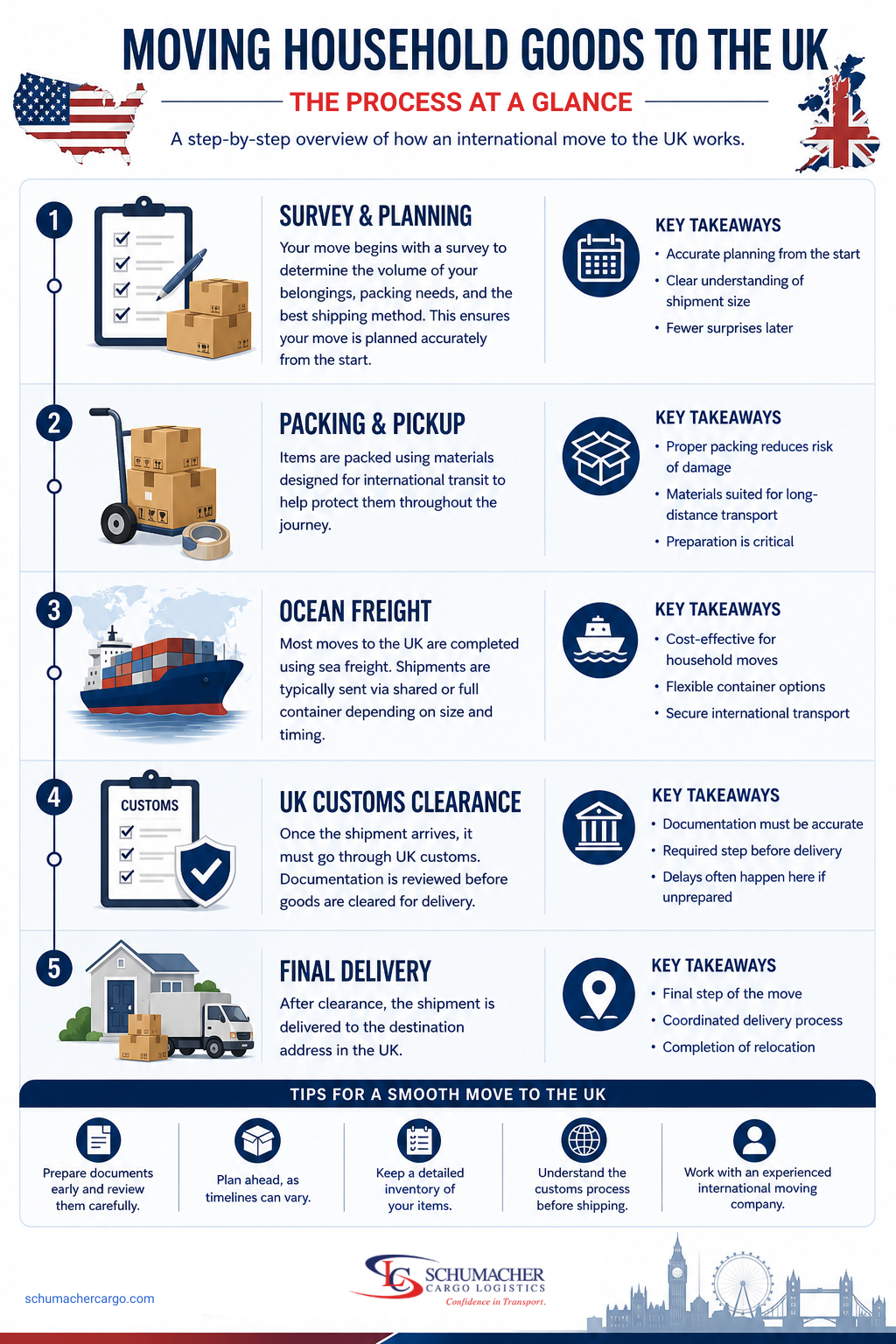
If you want a broader overview of how the process works, including timelines and delivery, visit our moving to the UK page for a complete breakdown.
UK Customs Requirements for Household Moves
To move your household goods into the UK, you will typically need:
- A copy of your passport
- Proof of residency or visa (if applicable)
- A detailed inventory of your shipment
If you are relocating permanently, your household goods may qualify for duty-free import, but only if all documentation is completed accurately.
Has Brexit Changed Anything for Americans?
Brexit primarily impacted trade between the UK and the European Union. For Americans moving from the U.S., the overall process has not fundamentally changed.
What has changed is how customs procedures are structured and enforced. Documentation and accuracy are more important than ever, which is why working with an experienced international mover matters.
In short, moving to the UK is not more difficult; it simply requires proper coordination.
Common Mistakes That Cause Delays
Some of the most common issues that can delay a move include:
- Incomplete or incorrect documentation
- Poor packing that leads to damage or inspection issues
- Attempting to handle customs without proper guidance
- Working with companies that do not manage the full moving process
Why Working With an International Moving Company Matters
International moving is a complex process that requires coordination across multiple stages.
Working with an experienced, full-service moving company ensures that:
- Your belongings are packed and handled properly
- Documentation is prepared accurately
- Customs clearance is managed efficiently
- Delivery is coordinated from start to finish
This level of support helps reduce stress and prevents unnecessary delays.
Plan Your Move to the UK With Confidence
If you’re planning a move to the UK, working with an experienced international moving company can make all the difference.
Schumacher Cargo Logistics provides full-service international moving solutions, handling everything from packing and shipping to customs clearance and final delivery.
Request a quote today to start planning your move with confidence.

For Americans considering an international move in 2026, Australia remains one of the most attractive and familiar-feeling destinations. With a shared language, high wages, strong public healthcare, and an outdoor-focused lifestyle, Australia appeals to both working professionals and retirees from the United States.
However, living in Australia is not simply “the USA with better beaches.” Housing costs, distance from the U.S., immigration rules, and taxes all play a major role in whether the move makes sense long-term.
Below is a practical comparison to help you decide whether living in Australia or the USA is the better fit for you in 2026.
Is Living in Australia Better Than the USA?
Short answer:
Australia offers Americans higher average wages, better work-life balance, and universal healthcare, but at a higher cost of living, with expensive housing and strict immigration requirements.
For many Americans, the tradeoff is worth it. For others, it depends heavily on career flexibility and lifestyle priorities.
Australia vs USA: Key Differences at a Glance (2026)
| Category | Australia | United States |
| Language | English | English |
| Healthcare | Universal public system | Private, employer-based |
| Wages | High minimum & average wages | Varies widely |
| Housing | Expensive in major cities | More availability |
| Work-life balance | Strong protections | Employer-dependent |
| Geography | Very remote from the U.S. | Central to global travel |
Pros of Living in Australia
No Language Barrier
For Americans, one of the biggest advantages of Australia is the lack of a language barrier. English is the primary language nationwide, making day-to-day life, professional work, and government processes much easier than in many other expat destinations.
While Australian slang may take some getting used to, communication is rarely a challenge.
High Standard of Living and Wages
Australia consistently ranks among countries with the highest quality of life. Wages are generally higher than in the U.S. for comparable roles, and the national minimum wage is significantly higher.
Combined with worker protections, paid leave, and healthcare access, many Americans find they can maintain a comfortable lifestyle despite higher costs.
Universal Healthcare System
Australia’s public healthcare system provides residents with access to essential medical services without the financial stress often associated with U.S. healthcare.
Many Australians still carry private insurance for elective procedures or faster access, but healthcare costs are far more predictable than in the U.S.
Work-Life Balance
Australian workplace culture generally emphasizes balance. Employees receive paid vacation time, paid sick leave, and protections that are not guaranteed in the U.S.
This focus on quality of life is one of the most appealing aspects for Americans used to long work hours and limited time off.
Outdoor Lifestyle and Climate
Australia’s climate and geography encourage an active, outdoor lifestyle. Beaches, national parks, and coastal cities make it easy to enjoy nature year-round.
For many Americans, the ability to combine city life with easy access to the outdoors is a major draw.
Cons of Living in Australia
High Cost of Housing
Housing is one of the biggest challenges for people moving to Australia. Major cities such as Sydney and Melbourne have extremely high home prices and rental costs.
While wages are higher, housing expenses can significantly impact overall affordability.
Distance from the United States
Australia’s geographic isolation can be difficult for Americans with close family ties in the U.S. Flights are long, expensive, and time-consuming.
Regular visits home are not as easy or affordable as they would be from Europe or Canada.
Strict Immigration Rules
Australia has a points-based immigration system that prioritizes skilled workers, specific occupations, and age limits.
Permanent residency is not guaranteed, and many visas are temporary or employer-sponsored.
Higher Cost of Goods and Services
Imported goods, electronics, and some consumer products are often more expensive in Australia.
This can be an adjustment for Americans accustomed to lower retail prices and wide availability.
Is Australia or the USA Better for Americans in 2026?
The answer depends on what you value most. Australia offers stability, healthcare security, and a slower-paced lifestyle. The U.S. offers flexibility, career mobility, and proximity to family for many Americans.
If quality of life, healthcare, and work-life balance are your priorities, Australia may be the better choice. If affordability, mobility, and career growth are more important, staying in the U.S. may make more sense.
Planning on a Move to Australia?
Carefully weighing the pros and cons—and understanding the practical realities of immigration, housing, and distance—can help ensure the move is the right one for you.
With over 40 years of experience, Schumacher Cargo Logistics is a trusted leader in international moving. Our team understands the unique challenges of overseas relocation, from shipping logistics to customs documentation and delivery coordination, ensuring your move is handled with care and expertise. Whether you need door-to-door household moving or vehicle shipping, choosing an experienced international mover like Schumacher can make your transition abroad noticeably smoother and less stressful.
Get a Free Custom Moving Quote
More Australia Moving Guides

For Americans considering a move abroad in 2026, the Netherlands consistently ranks among the most appealing options. Known for its strong work-life balance, walkable cities, and high quality of life, the Netherlands offers a very different day-to-day experience compared to the United States.
Below is a clear, practical comparison to help you decide whether living in the Netherlands or the USA makes more sense for you in 2026.
Is Living in the Netherlands Better Than the USA?
For many Americans, the Netherlands offers better work-life balance, easier access to healthcare, and a more walkable lifestyle, but at the cost of higher housing competition, higher taxes, and less living space.
The right choice depends on your priorities, career flexibility, and tolerance for tradeoffs.
Netherlands vs USA: Key Differences at a Glance (2026)
| Category | Netherlands | United States |
| Healthcare | Universal, regulated | Private, employer-based |
| Work-life balance | Strong labor protections | Varies by employer |
| Housing | Competitive, limited supply | More space, more availability |
| Transportation | Public transit & biking | Car-dependent |
| Language | English widely spoken | English primary |
| Taxes | Higher but includes services | Lower but fragmented services |
Pros of Living in the Netherlands
Excellent Work-Life Balance
The Netherlands is widely known for its healthy relationship with work. Employees benefit from legally protected vacation time, parental leave, and reasonable working hours. Compared to the U.S., where benefits vary significantly by employer, Dutch labor protections are more consistent and predictable.
High Quality of Life
Dutch cities regularly rank among the world’s most livable. Clean infrastructure, safe neighborhoods, strong social systems, and an emphasis on well-being all contribute to a high overall quality of life, especially for families and professionals seeking stability.
Easy Transportation and Car-Free Living
Public transportation in the Netherlands is efficient, reliable, and extensive. Trains, trams, buses, and cycling infrastructure make it possible to live comfortably without owning a car, a major lifestyle shift for Americans used to driving everywhere.
Low Language Barrier for English Speakers
Although Dutch is the official language, English proficiency is extremely high. Most Americans can navigate daily life, government offices, and professional environments without speaking Dutch fluently, especially in major cities.
Cons of Living in the Netherlands
Housing Is Competitive and Expensive
The Dutch housing market remains one of the biggest challenges for expats in 2026. Rental availability is limited, competition is intense, and prices in cities like Amsterdam, Utrecht, and Rotterdam can be high relative to the space available.
Many Americans are surprised by:
- Smaller living spaces
- Strict rental requirements
- Limited short-term availability
- Higher Taxes Compared to the USA
Income taxes and social contributions in the Netherlands are higher than in the U.S.
While these taxes fund healthcare, infrastructure, and social services, Americans accustomed to lower tax rates may experience sticker shock.
Immigration Rules Matter
Americans cannot simply move to the Netherlands indefinitely without proper residency authorization. Visas, work permits, and registration requirements play a major role in whether a move is feasible.
Cost of Living: Netherlands vs USA
In 2026, the cost of living in the Netherlands is generally higher than in many U.S. cities, but lower than in major U.S. metros like New York or San Francisco.
Key differences:
- Housing: More expensive per square foot in the Netherlands
- Healthcare: Significantly cheaper overall
- Transportation: Much cheaper without a car
- Groceries: Comparable, with higher quality standards
The tradeoff is paying more upfront in rent while saving on healthcare, commuting, and long-term stability.
Healthcare: A Major Difference for Americans
Healthcare is one of the biggest lifestyle differences between the Netherlands and the U.S.
In the Netherlands:
- Health insurance is mandatory
- Costs are regulated
- Coverage is comprehensive
- Access is not tied to employment
For Americans used to employer-based insurance, the Dutch system often feels simpler, more predictable, and less stressful.
Who the Netherlands Is a Good Fit For
The Netherlands may be a strong choice if you:
- Value work-life balance over long work hours
- Want to live without a car
- Work remotely or in international industries
- Prefer walkable cities and public transit
- Want predictable healthcare costs
It may not be ideal if you:
- Need large living spaces
- Want low taxes
- Prefer suburban or rural lifestyles
- Rely on U.S.-specific employment structures
Planning an International Move to the Netherlands
Relocating internationally involves more than just choosing a country. Shipping household goods, vehicles, and personal belongings requires careful planning, compliance with customs regulations, and realistic timelines.
With over 40 years of experience, Schumacher Cargo Logistics is a trusted leader in international moving. Our team understands the unique challenges of overseas relocation, from shipping logistics to customs documentation and delivery coordination, ensuring your move is handled with care and expertise. Whether you need door-to-door household moving or vehicle shipping, choosing an experienced international mover like Schumacher can make your transition abroad noticeably smoother and less stressful.
Get a Free Custom Moving Quote
Frequently Asked Questions
Is the Netherlands better than the USA for families?
Many families prefer the Netherlands for its healthcare system, education standards, and work-life balance, though housing space is typically smaller than in the U.S.
Can Americans move to the Netherlands permanently?
Yes, but only with proper residency authorization. Americans must qualify through work, business, or other legal residency pathways.
Do I need to speak Dutch to live in the Netherlands?
Dutch is helpful, but not required initially. English is widely spoken, especially in cities.
Is it expensive to live in the Netherlands?
Housing can be expensive, but healthcare, transportation, and everyday costs can offset higher rent compared to many U.S. cities.
More on Moving to the Netherlands: